Community Owned Micro Hydro (PLTMH): What Makes It Last
Many village micro hydro plants in Indonesia have broken down or been abandoned. This guide explains how a PLTMH works, how communities run one, and the choices that keep it generating for years
Key Points
- Design for dry season flow and protect the forest above the intake: low water is a leading cause of idle plants
- Set tariffs from real operating and repair costs, keep a maintenance fund and report the accounts to users
- Train local operators, secure spare parts and use daytime power for village businesses
- Plan for the PLN grid from the start: a legal entity and a network built to standard keep interconnection possible
On This Page
A community micro hydro plant, known in Indonesia as PLTMH (pembangkit listrik tenaga mikrohidro), can give a remote village clean electricity for decades. More than 1,300 have been built in Indonesia since the 1990s, most with government funding, yet many have broken down or been abandoned, for reasons that can often be anticipated in planning
This guide for donors, local governments, energy BUMN, NGOs and village leaders explains how a plant works, how communities run it, what keeps it going and how to measure results
What Micro Hydro Is and How Indonesia Defines PLTMH
Most micro hydro schemes are run of river: a small weir diverts part of a stream, the water drops through a pipe to a turbine and returns to the same river, with little or no storage. Output depends on the head, the vertical drop between intake and turbine, and the flow, the volume of water passing each second
Size labels vary. IRENA calls plants of 5 to 100 kW micro hydro and 100 kW to 1 MW mini hydro. ESDM's 2013 rural energy grant guidelines defined PLTMH more broadly, as a small plant below 1 MW fed by a river, irrigation channel or waterfall, and a 2023 review found that micro hydro in Indonesia typically means 10 kW to just under 1 MW. Most village plants are far smaller: a World Bank study puts most isolated schemes at 5 to 40 kW
How a Community Micro Hydro Scheme Works
A typical scheme is a chain of six parts:
- Weir and Intake
- Headrace Channel
- Forebay
- Penstock
- Turbine and Generator
- Village Distribution Network
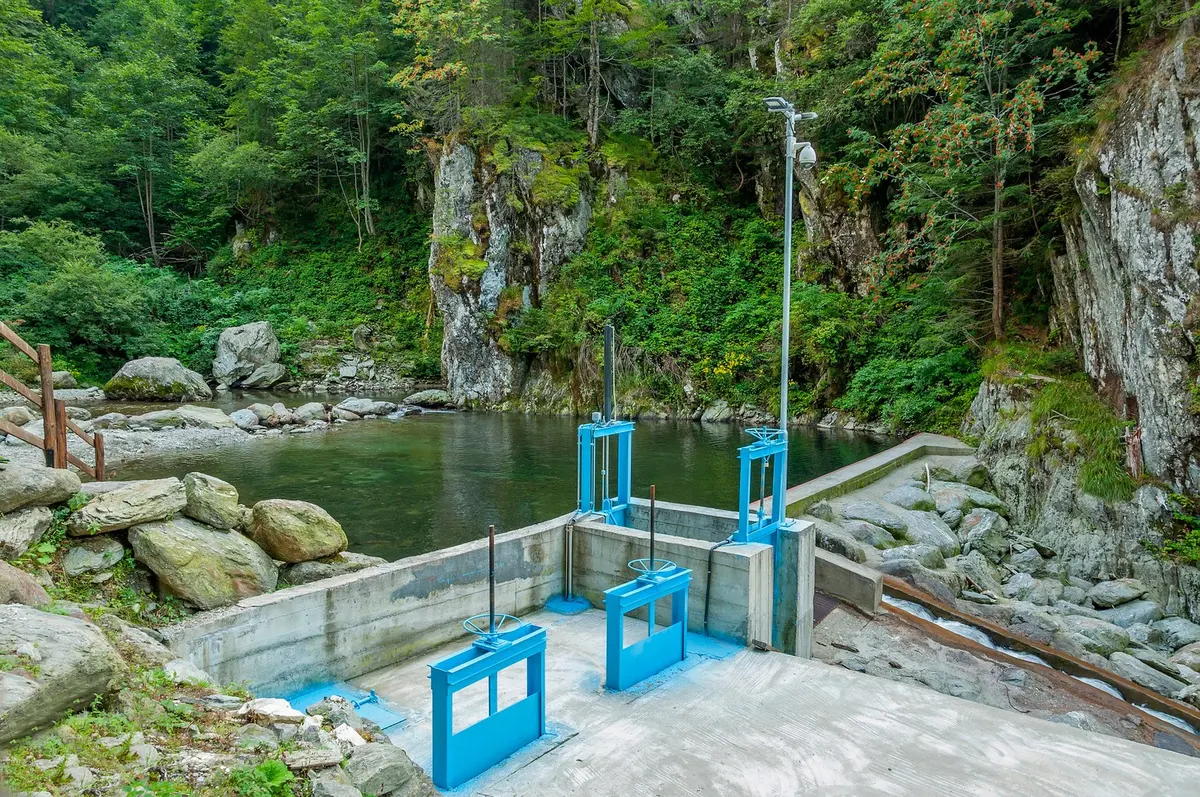
The intake has a trash rack and gates, and a settling basin traps sediment where needed. The forebay steadies the flow and screens out debris before the water enters the penstock, the pressure pipe down to the powerhouse. There the turbine drives a generator, and an electronic load controller sends power that users are not drawing to a ballast heater. A tailrace returns the water to the river
Why Community Ownership Matters and How It Is Organized
The 2023 review found that the most successful and sustainable projects bring local economic benefits and give communities ownership and responsibility for maintenance
The rules depend on the funder. ESDM's 2013 grant guidelines asked communities to choose a management body by village deliberation (musyawarah) and to be ready to pay usage fees at a fair price. For plants the ministry builds, ESDM Regulation 39/2017, amended in 2018, lets the proposing local government appoint a regional enterprise, a cooperative or a community group as manager, and makes the manager responsible for funding operation and maintenance after handover. North Kalimantan's 2019 governor regulation lists a BUM Desa, cooperative, foundation or user group as possible managers, with a chair, secretary, treasurer and operator, and expects user fees to cover costs and emergency savings. For BUM Desa management, see our article on strengthening BUM Desa
What Makes a PLTMH Last
Seven factors recur in Indonesian studies and guidelines
Study the River Across Seasons
Design for the dry season. In EnDev Indonesia's 2012 survey of 47 village plants, low dry season flow was the most common reason inactive plants had stopped, and reviews describe plants built without proper feasibility studies. Measure flow through at least one dry season, check landslide risk and verify demand: in that survey only about 60 percent of planned households had been connected
Protect the Catchment
EnDev found that deforestation appeared to be the root cause of poor performance at several sites, which also suffered more floods and landslides. IRENA notes that forested watersheds sustain dry season flow and help prevent erosion and mudslides. Village rules that protect upstream forest and share water fairly with irrigation belong in the plan
Set Tariffs That Cover Real Costs
Many plants set tariffs by willingness to pay rather than by calculation, and the World Bank study found tariffs often too low to fund repairs. Start from the monthly cost of operator pay, routine maintenance and savings for major parts, then check affordability. EnDev recommended consumption based tariffs as demand grows, and some villages set fees by the size of each household's circuit breaker
Train Operators and Secure Spare Parts
Operators check the intake, channel and penstock, clear debris, grease bearings and fix small leaks early. In the EnDev survey, turbines, generators, controllers, channels and forebays broke down most often. ESDM's 2018 grant guidelines required suppliers to provide main spare parts, tools, a manual and a two year maintenance warranty, so agree early who pays for repairs after that. In Kamanggih village on Sumba, two young villagers received vocational scholarships to become operators
Put the Electricity to Work
Most plants can generate far more than households use, especially by day. In the EnDev survey most ran only at night, and some village rules even banned business use to protect evening supply. Productive use brings in revenue and gives more people a stake in the plant: in Tepal hamlet on Sumbawa, a cooperative runs two small plants mainly for coffee production and repaired a 2014 breakdown without outside help. This is rural development as much as energy work
Make Ownership and Accountability Clear
Publicly funded plants usually remain district or provincial assets run by a community body, and slow handovers have left some with unclear ownership and legal status. Agree in writing who owns the plant, who manages it, who sets tariffs and who pays for major repairs. Keep a log book, fee book and cash book, and report to users: only 15 of the 47 EnDev sites kept records clear enough to show whether they were saving enough
Plan for the Arrival of the PLN Grid
EnDev advised allowing for PLN grid expansion within two to five years. Of about 200 Indonesian plants the grid reached, the World Bank study found most were abandoned, about 50 kept serving customers alongside PLN and only 9 connected to sell power to PLN. Since 2017, ESDM rules have let ministry funded plants sell electricity to PLN under 20 year agreements if a legal entity such as a cooperative manages them, with the revenue going to operation and maintenance. When PLN reached Kamanggih in 2013, the village cooperative negotiated a power purchase agreement and kept running its 37 kW plant. A network built to utility standards keeps that option open
Why Micro Hydro Plants Stop Working
Indonesian studies find that causes usually come in combination:
- Low dry season flow, often worse where upstream forest has been cleared
- Floods and landslides that damage the weir, channel or powerhouse
- Broken equipment left unrepaired for lack of money, skills or parts
- Overload as households add appliances
- Tariffs too low to fund repairs, often with weak bookkeeping
- Conflicts within the village or over water for farming
- Arrival of the PLN grid without a plan
In EnDev's survey, 8 of the 47 plants were not delivering electricity when surveyed, and more than half had suffered at least one breakdown
How to Measure Results
Track a few indicators from the first month, against a baseline taken before construction. EnDev Indonesia's 2012 KPI survey offers a tested starting set:
| Indicator | How to Measure | What It Shows |
|---|---|---|
| Operating hours and availability | Hour meter and log book | Reliability of supply |
| Households and public facilities connected | Customer register, checked against the plan | Reach of the service |
| Productive users | Businesses using power, kWh if metered | Economic value of the plant |
| Fee collection rate | Fees collected divided by fees billed | Financial health and user trust |
| Maintenance fund balance | Cash book and bank statement | Ability to pay for repairs |
| Income and services | Baseline and follow up household surveys | Change in livelihoods and services |
Fit kWh meters, as EnDev recommended: many plants in its survey could not show how much electricity they supplied, and on average plants were available only about 63 percent of the expected time
Conclusion
A community micro hydro plant lasts when it is treated as a village service rather than a construction project: designed for the dry season, protected upstream, priced to cover its costs, run by trained people with clear authority, used for income as well as light, and ready for the day PLN arrives. Funders can build each of these conditions into project budgets from the start
SIDIA's Renewable Energy program supports PLTMH feasibility and design, installation and maintenance arrangements, and community capacity building, and its Strategic Advisor, Tri Mumpuni, received the 2011 Ramon Magsaysay Award for promoting micro hydropower technology and full community participation in bringing electricity to rural Indonesia
Frequently Asked Questions
What is a PLTMH?
PLTMH (pembangkit listrik tenaga mikrohidro) is a small run of river hydropower plant that uses the head and flow of a river, irrigation channel or waterfall. ESDM's 2013 grant guidelines defined it as a plant below 1 MW, while international size bands reserve the term micro hydro for 5 to 100 kW
How much electricity can a village micro hydro plant produce?
It depends on the head and flow at the site, so every site needs its own measurements. Most isolated village plants in Indonesia are between 5 and 40 kW, and the plants in EnDev's 2012 survey averaged about 13 kW and served around 70 households each
Who owns a community micro hydro plant in Indonesia?
It depends on who paid for it. Plants built with public funds are usually government assets run by a community body, while NGO supported plants are often owned by a cooperative or village association. A BUM Desa, cooperative or user group can manage a plant if the roles are set in writing
What happens to a micro hydro plant when the PLN grid arrives?
Many Indonesian plants were abandoned when the grid arrived, some kept serving customers alongside PLN, and a few connected to sell electricity to PLN. Since 2017, ESDM rules have allowed ministry funded plants to sell power to PLN if a legal entity manages them
Sources
- Peraturan Menteri Energi dan Sumber Daya Mineral Nomor 03 Tahun 2013 tentang Petunjuk Teknis Penggunaan Dana Alokasi Khusus Bidang Energi Perdesaan Tahun Anggaran 2013Kementerian Energi dan Sumber Daya Mineral (ESDM), 2013
- Peraturan Menteri Energi dan Sumber Daya Mineral Nomor 39 Tahun 2017 tentang Pelaksanaan Kegiatan Fisik Pemanfaatan Energi Baru dan Energi Terbarukan serta Konservasi EnergiKementerian Energi dan Sumber Daya Mineral (ESDM), 2017
- Peraturan Menteri Energi dan Sumber Daya Mineral Nomor 12 Tahun 2018 tentang Perubahan atas Peraturan Menteri Energi dan Sumber Daya Mineral Nomor 39 Tahun 2017Kementerian Energi dan Sumber Daya Mineral (ESDM), 2018
- Peraturan Menteri Energi dan Sumber Daya Mineral Nomor 36 Tahun 2018 tentang Petunjuk Operasional Pelaksanaan Dana Alokasi Khusus Fisik Bidang Energi Skala KecilKementerian Energi dan Sumber Daya Mineral (ESDM), 2018
- Peraturan Gubernur Kalimantan Utara Nomor 16 Tahun 2019 tentang Tata Kelola Pembangkit Listrik Tenaga Mikrohidro Berbasis MasyarakatPemerintah Provinsi Kalimantan Utara, 2019
- Over a century of small hydropower projects in Indonesia: a historical reviewRospriandana, Burke, Suryani, Mubarok and Pangestu, Energy, Sustainability and Society 13:30, 2023
- Mini Grids and the Arrival of the Main Grid: Lessons from Cambodia, Sri Lanka, and IndonesiaEnergy Sector Management Assistance Program (ESMAP), World Bank, 2018
- Survey on Key Performance Indicators for Indonesian Micro-hydro Power SitesEnergising Development (EnDev) Indonesia, GIZ, 2012
- Sustainability Challenge of Micro Hydro Power Development in IndonesiaDidik H. et al., IOP Conference Series: Earth and Environmental Science 147, 2018
- Renewable energy benefits: Leveraging local capacity for small-scale hydropowerInternational Renewable Energy Agency (IRENA), 2023
- Tri MumpuniRamon Magsaysay Award Foundation, 2011
Need Help With This?
Our team can help you design, measure, and report programs like the ones discussed in this article